Key takeaways
- A graft is a naturally occurring follicular unit containing 1 to 4 hair follicles; it is not the same as an individual single hair.
- Required graft counts range from 1,200 to 2,000 for early receding hairlines (Norwood 2-3) up to 4,000 to 5,500+ for extensive baldness (Norwood 5-6).
- Safe donor harvesting must never exceed 30% to 35% of occipital density to avoid visible patchy thinning or donor depletion.
- Hair characteristics such as shaft diameter, curl and skin-to-hair color contrast strongly influence perceived visual density.
The short answer
Most hair transplants require between 1,500 and 4,500 grafts depending on the surface area to be covered and your natural donor density. A receding hairline or temporal restoration typically needs 1,500 to 2,200 grafts, whereas restoring front, mid-scalp and crown together often requires 3,500 to 5,000 grafts. An exact calculation requires trichoscopy to measure your donor density and donor follicular group sizes before surgery.
Follicular units vs individual hairs
In modern hair restoration, surgeons transplant follicular units, not isolated hairs. A natural follicular unit is an anatomical bundle that contains 1, 2, 3 or occasionally 4 hair follicles, complete with their sebaceous glands, arrector pili muscles and microvascular support.
When evaluating a clinic quote or surgical plan, always verify whether the figure quoted refers to follicular unit grafts or individual hairs. In Indian and South Asian scalps, the average hair-to-graft ratio is approximately 2.1 to 2.3. Therefore, 2,000 follicular unit grafts equal roughly 4,200 to 4,600 hairs. Clinics that market hair counts instead of graft counts may quote an artificially high number to make a procedure appear larger.
Graft requirements by hair-loss stage
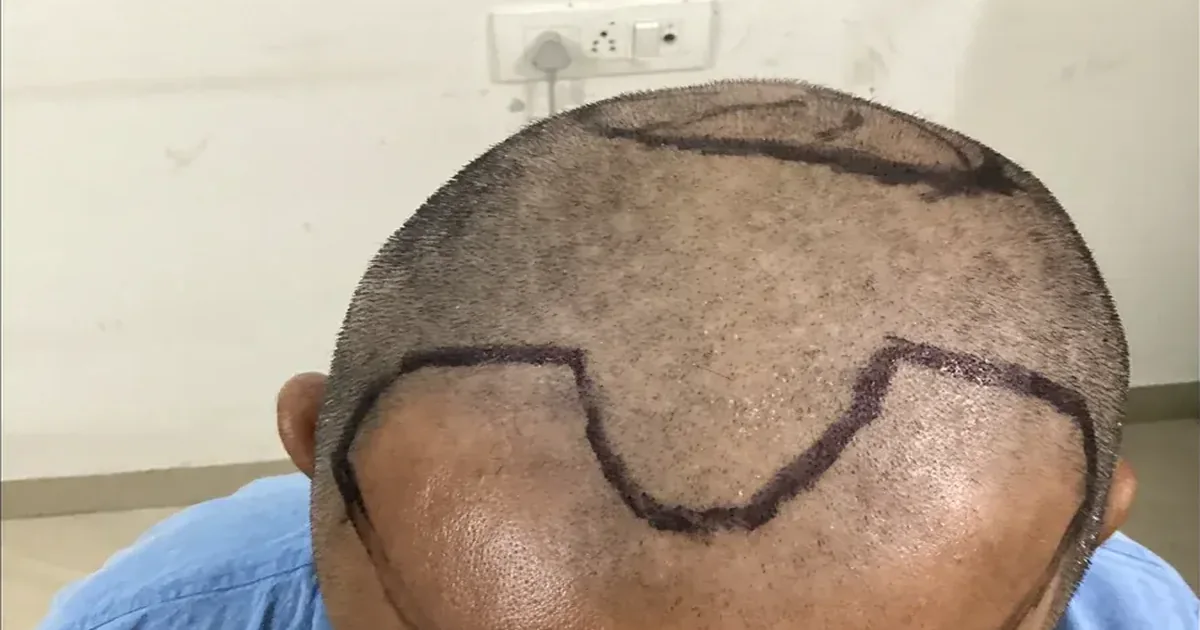
The Norwood classification system provides the primary clinical framework for mapping male pattern baldness. Here is an overview of typical graft ranges used in clinical planning:
| Norwood stage | Pattern & coverage area | Typical graft range | Estimated hair count |
|---|---|---|---|
| Stage 2 | Mild temporal recession; surgical intervention rarely indicated yet | 800 – 1,200 (if stable) | 1,600 – 2,500 |
| Stage 3 | Deep temporal recession, frontal hairline reshaping | 1,500 – 2,200 | 3,100 – 4,800 |
| Stage 3 Vertex | Frontal hairline plus early thinning on the crown / vertex | 2,000 – 2,800 | 4,200 – 6,000 |
| Stage 4 | Pronounced frontal recession with mid-scalp and crown thinning | 2,500 – 3,500 | 5,200 – 7,500 |
| Stage 5 | Extensive front-to-crown balding separated by narrow thinning bridge | 3,500 – 4,500 | 7,300 – 9,500 |
| Stage 6 | Front, mid-scalp and crown confluent; bridge is lost | 4,500 – 5,500+ | 9,500 – 12,000+ |
| Stage 7 | Only horseshoe perimeter remains; requires multi-step planning | 5,000+ (donor limited) | Requires body / beard hair |
Factors that change your required graft count
Two people with identical hairline recession may require significantly different graft counts due to specific anatomical characteristics:
- Hair shaft caliber (thickness): Coarser hair provides substantially greater light-blocking surface area than fine hair. A patient with thick hair shafts can often achieve satisfactory optical density with 35 to 40 grafts per square centimetre, whereas fine hair may require 45 to 50 grafts per square centimetre.
- Hair curl and texture: Wavy or curly hair stands off the scalp and curves over adjacent skin, creating higher perceived coverage per graft than straight hair.
- Contrast between scalp and hair: When hair color closely matches scalp skin tone (such as dark hair on wheatish-tan skin), less contrast is visible to the eye, reducing the graft volume required to achieve a natural cosmetic result.
- Size of the cranial vault: A larger head circumference translates into a greater square-centimetre recipient area, proportionally increasing the graft count needed for complete coverage.
The safe donor zone and donor depletion
The permanent donor area at the back and sides of the head contains a finite number of androgen-insensitive hair follicles. In most men, the safe donor zone yields between 5,500 and 7,000 lifetime follicular units without visibly thinning the donor region.
Over-harvesting occurs when an aggressive surgical plan extracts more than 30% to 35% of the native density in a single area. This results in patchy, moth-eaten scalp skin, visible scarring through short hairstyles, and leaves no reserve for future hair loss. At Kezza Clinic, donor density is assessed with digital trichoscopy before surgery to confirm safe extraction limits.
Strategic graft distribution: Hairline vs Crown
Because donor supply is finite, hair transplant surgeons prioritize graft placement strategically:
- Zone 1: The Transition Zone (Hairline): The anterior 0.5 to 1.0 cm is planted exclusively with delicate, single-hair grafts placed at acute angles (15 to 20 degrees) in an irregular, micro-feathered pattern to replicate a natural hairline.
- Zone 2: The Frontal Core & Mid-Scalp: Two- and three-hair follicular units are placed at higher density (40 to 45 grafts/cm²) behind the transition zone to create maximum cosmetic impact when looking straight in the mirror.
- Zone 3: The Crown (Vertex): The crown has a spiral (whorl) pattern that expands radially, requiring high graft numbers to achieve density. In young patients with progressing hair loss, surgeons often treat the crown conservatively with medical therapy or PRP therapy to conserve donor follicles for the frontal zones.
Planning your procedure at Kezza
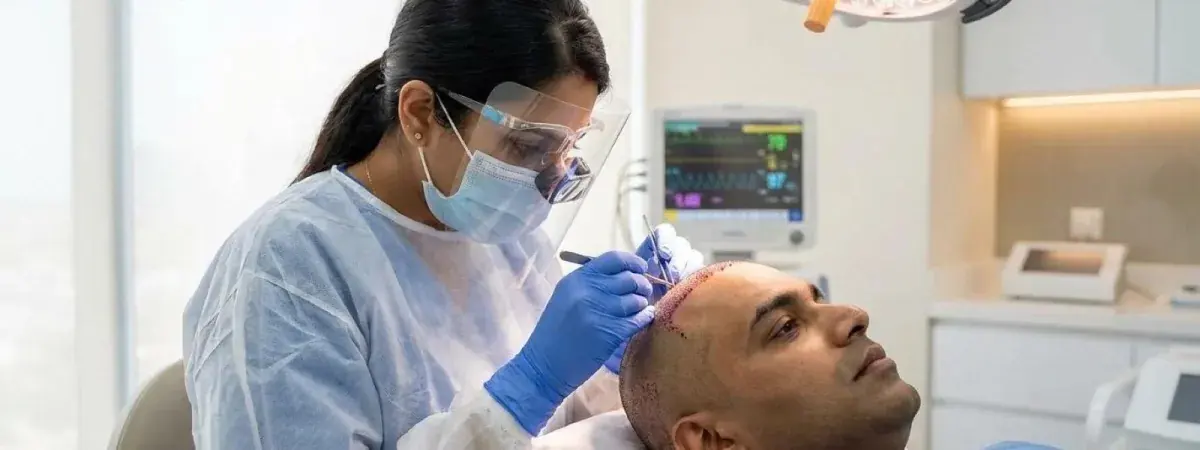
During a consultation at our Jaipur, Sikar or Ajmer clinics, our surgical team uses high-magnification trichoscopy to measure follicular unit density per square centimetre, calculate your hair-to-graft ratio, and design a balanced hairline. Learn more about our hair transplant procedures or read our guide on hair transplant costs in Jaipur.
Considering clinical treatment?
Our aesthetic physicians and surgeons provide personalized clinical assessments at our Jaipur, Sikar and Ajmer clinics.
Sources
- International Society of Hair Restoration Surgery (ISHRS): Graft estimation principles
- Dermatologic Surgery: Safe donor zone harvesting and follicular density guidelines
- Journal of Cutaneous and Aesthetic Surgery: Planning mega-sessions in follicular unit extraction
- American Academy of Dermatology: Hair loss clinical assessment
This article is general health information, not a diagnosis or a substitute for a consultation. Treatment suitability, number of sessions and results vary from person to person; please speak to a doctor about your own situation.

Kezza Hair & Skin Clinic is a doctor-led hair, skin and aesthetics clinic with branches in Jaipur, Sikar and Ajmer. Meet our doctors. Related treatments: Hair transplant in Jaipur · FUE hair transplant · DHI hair transplant · Norwood scale guide