Key takeaways
- FUE and DHI extract grafts the same way: one follicular unit at a time with a tiny punch. They differ in how grafts are implanted.
- In FUE, the surgeon makes all the recipient sites first and places grafts with fine forceps. In DHI, a pen-like implanter makes the site and places the graft in one step.
- DHI suits smaller areas, dense packing and working between existing hair. FUE with pre-made sites is often preferred for large sessions.
- In experienced hands graft survival is similar, so the surgeon, the team and your donor area matter more than the technique's name.
The short answer
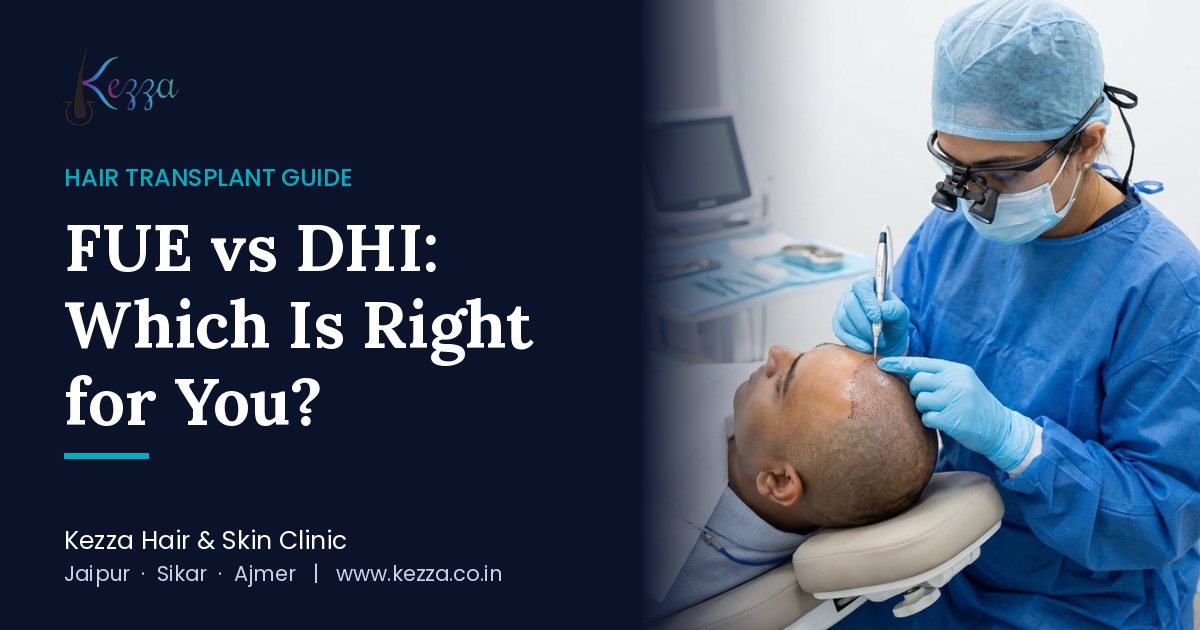
FUE and DHI are two ways of doing the same basic operation. In both, the surgeon removes individual follicular units from the back and sides of your scalp. The difference is the second half of the procedure. In FUE, tiny recipient sites are made first and the grafts are then placed with forceps. In DHI, each graft is loaded into a pen-like implanter that makes the site and places the graft in one movement. Neither is "better" for every patient: the right choice depends on the area to cover, how much native hair you still have and how many grafts you need.
How FUE works
Follicular unit excision (FUE) removes natural groups of one to four hairs, one at a time, using micro-punches roughly 0.7 to 1.2 mm wide. The punches can be manual, motorised or robotic. Because each graft is taken individually, FUE leaves tiny dot scars rather than the linear scar of the older strip method (FUT), and it can use beard or body hair as extra donor supply when needed.
Once the grafts are harvested, the surgeon designs the hairline and creates recipient sites in the thinning area, controlling the angle, direction and depth of every incision. Sites are made with fine steel or sapphire-tipped blades; "sapphire FUE" simply means sapphire blades were used for this step. The team then places each graft into its site with fine forceps.
How DHI works
Direct hair implantation (DHI) uses exactly the same extraction. The difference is implantation: harvested grafts are loaded into implanter pens (often called Choi pens), and the surgeon uses the pen to create the channel and deposit the graft in a single "stick-and-place" motion. Because grafts go into the scalp soon after they are loaded, DHI can reduce the time grafts spend outside the body.
DHI gives fine control over angle and depth one graft at a time, which is useful for dense packing in small areas and for placing grafts between existing hairs without disturbing them. The trade-off is speed: implanting every graft with a pen is slower, so very large sessions are harder to complete in one day.
FUE vs DHI at a glance
| FUE (with pre-made sites) | DHI (implanter pen) | |
|---|---|---|
| Graft extraction | Individual follicular units with a micro-punch | Same as FUE |
| Implantation | All sites made first, grafts placed with forceps | Pen makes the site and places the graft together |
| Often suits | Larger areas, front and crown together, big sessions | Hairline refinement, dense packing, gaps between existing hair |
| Shaving | Recipient area usually shaved | Less shaving possible for small, selected cases |
| Planning | Surgeon sees the whole site pattern before placing grafts | Pattern built graft by graft |
| Scarring | Tiny dot scars in the donor area | Same as FUE |
| Recovery | Scabs clear in 1 to 2 weeks | Same as FUE |
Which technique gives better results?
There is no strong evidence that one technique consistently produces more growth than the other. Graft survival depends mainly on how carefully grafts are handled: how fast they are extracted, how they are stored, how gently they are placed and how experienced the team is. Experienced surgeons report similar survival with both methods, and a skilled FUE team with good storage solutions can match the survival benefit that DHI's shorter out-of-body time is meant to provide.
What changes outcomes far more is the plan: a hairline that suits your face and age, a graft count your donor area can safely supply, and medical therapy to protect the hair you still have. The American Academy of Dermatology notes that a transplant can be an effective, lasting solution for pattern baldness, but native hair can keep thinning, which is why many doctors combine surgery with medication or PRP or GFC therapy.
Who is a good fit for each?
DHI may suit you if
- You need a hairline refinement or want to add density to a small area.
- You still have hair in the area and want grafts placed between existing hairs.
- You would prefer to avoid a full shave and your case is small enough for that.
FUE may suit you if
- You need a larger area covered, such as the front and crown together (Norwood stage 4 and above).
- Your plan needs more grafts in one session than pen implantation can comfortably place in a day.
- Your surgeon wants to map every recipient site before placing grafts.
Some clinics combine the two, using DHI for the hairline and FUE site-making behind it. Not sure where you stand? Our guide to the Norwood scale explains how hair-loss stage affects the plan.
Is recovery faster with DHI?
Recovery is essentially the same, because the extraction is the same and both leave tiny wounds in the recipient area. Small scabs form and are gently washed away over one to two weeks. Transplanted hairs usually shed between weeks 2 and 6, while the roots stay in place. Hair grows about 1 cm a month, so new growth becomes visible from around month 3 to 4, and the full result takes a year or more. At Kezza, most people return to desk work in 3 to 4 days and avoid the gym for about 2 weeks.
Questions to ask your surgeon
- Who will do each step? The International Society of Hair Restoration Surgery (ISHRS) warns about clinics where unqualified technicians perform the surgery. Ask to know which doctor is operating.
- How many grafts do I need, and can my donor area supply them? Ask for the graft estimate in writing.
- Why this technique for me? A good answer refers to your area, density goals and donor, not just the technique's name.
- What happens after surgery? Ask about medicines, washing instructions and follow-up reviews. Kezza reviews patients at 10 days, 1, 3, 6 and 12 months.
How we choose at Kezza
At your consultation, the doctor examines your scalp with trichoscopy, grades your hair loss, measures donor density and discusses the density you want. From that, we recommend FUE, DHI or a combination, and you get a written estimate before you decide. Hair transplant consultations are available at our Jaipur, Sikar and Ajmer clinics. Read more about hair transplant at Kezza, or see what decides the cost.
Sources
- ISHRS: FUE hair transplant, process and recovery
- Shapiro Medical Group: DHI vs FUE hair transplant
- ISHRS Fight the FIGHT: Beware of illegal hair transplants
- American Academy of Dermatology: Hair loss diagnosis and treatment
This article is general health information, not a diagnosis or a substitute for a consultation. Treatment suitability, number of sessions and results vary from person to person; please speak to a doctor about your own situation.

Kezza Hair & Skin Clinic is a doctor-led hair, skin and aesthetics clinic with branches in Jaipur, Sikar and Ajmer. Meet our doctors. Related treatments: Hair transplant in Jaipur · PRP & GFC therapy