
Treatments for each type of scar
There is no single best treatment for acne scars. Mayo Clinic notes that no single treatment is best for everyone, and that one treatment or a combination may be used depending on the type of scarring. These are the main options your doctor may use:
- Subcision for rolling scars. A fine needle is passed under the scar to release the fibrous bands that pull the skin down. Once freed, the skin can lift, and the space fills with new tissue as it heals.
- Microneedling radiofrequency (MNRF) for boxcar and rolling scars. Very fine needles deliver radiofrequency heat below the surface, which triggers the skin to make new collagen while leaving most of the surface intact.
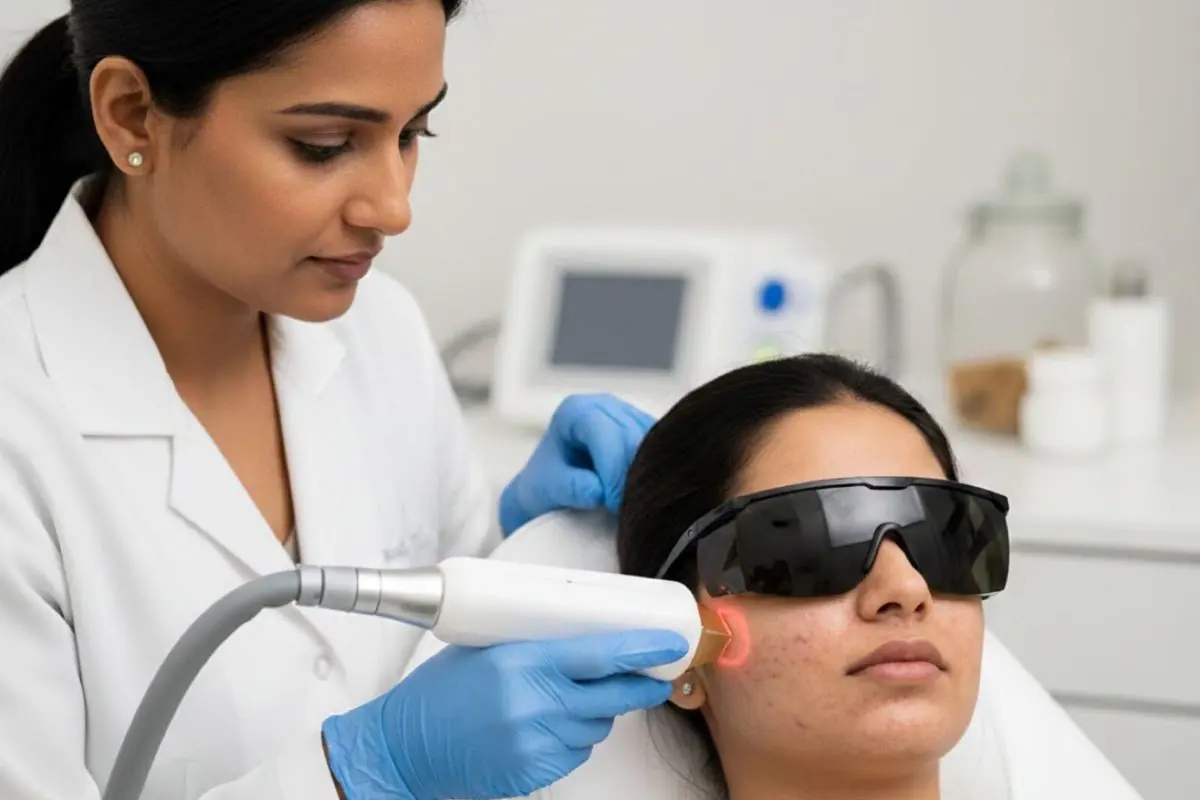
- Fractional laser resurfacing, such as fractional CO2 laser, for boxcar scars and uneven texture. The laser treats tiny columns of skin at a time, and the untreated skin between them speeds up healing. It gives more change per session than gentler options but also more downtime.
- Chemical peels for shallow scars and uneven tone. Superficial and medium-depth peels are repeated every few weeks. Deep peels are generally avoided on brown skin because of the risk of colour changes.
- Treatments for deep ice pick scars. Very narrow, deep scars sometimes need a targeted technique, such as a focused chemical application or a small punch procedure. Your doctor will explain whether this suits your scars.
- Treatments for raised scars. Hypertrophic scars and keloids are usually treated with steroid injections into the scar, silicone gel or sheets, or laser, often in combination.
Why combined plans work better
Most faces have a mix of scar types, and each responds to a different method. A typical plan might release rolling scars with subcision first and then smooth the surface over several sessions of microneedling RF or fractional laser, with peels in between to even out skin tone. The American Academy of Dermatology also notes that treatments such as platelet-rich plasma (PRP) are sometimes added to microneedling to improve results. Your doctor will explain the order, the number of sessions and the downtime before you start.
Acne scar treatment for Indian skin
Brown skin heals well, but it reacts to inflammation by making extra pigment. That is why some people notice dark patches after an aggressive peel or laser session. DermNet notes that post-inflammatory hyperpigmentation and keloid scarring are both more common in skin of colour. To lower the risk, your doctor may use gentler settings, allow more time between sessions, prescribe a skin care routine to prepare the skin, and ask you to be strict about sun protection throughout your course.
Aftercare between sessions
- Wash with a gentle cleanser and apply a plain moisturiser for the first few days.
- Use a broad-spectrum sunscreen every day and avoid direct sun, especially in the first week after a session.
- Let any crusts or flakes fall off on their own; do not pick or scrub the skin.
- Pause retinoids, acids and other active products for as long as your doctor advises, then restart gradually.
- Contact the clinic if you notice increasing pain, swelling, pus or blistering.
Why patients choose Kezza for acne scars
- Scar typing first: the doctor identifies ice pick, boxcar, rolling and raised scars, because each responds to different treatment.
- Combined plans: subcision, MNRF, fractional laser and peels are combined when that gives a better result than one method alone.
- Settings for Indian skin: energy levels, peel strength and the gap between sessions are chosen to lower the risk of dark marks.
- Three clinics: Jaipur, Sikar and Ajmer, open 9 AM to 8 PM every day.
- Clear costs: the number of sessions and the total cost are explained before you start.
What affects the cost of acne scar treatment?
The cost depends on the number and types of scars, the treatments used and how many sessions you need. A few shallow scars may need a short course, while deep or widespread scarring usually needs a longer plan that combines methods. Your doctor explains the plan and the likely number of sessions after your examination, so you can see the whole course before you decide.
Further reading
- Acne Scars Treatment Options: Subcision, MNRF & Laser Resurfacing
- Chemical Peels vs Laser Toning: Pigmentation & Post-Acne Marks
- Hydra Facial Treatment: Steps, Benefits & Deep Pore Cleansing
Sources & Clinical References
- American Academy of Dermatology (AAD): Acne Scars Consultation & Multimodal Treatment
- DermNet: Clinical Classification and Pathophysiology of Acne Scarring
- Mayo Clinic: Acne Scars — Evaluating Subcision, Lasers & Microneedling
- Dermatologic Surgery: Fractional Radiofrequency vs Fractional CO2 Laser in Atrophic Acne Scars
- Indian Journal of Dermatology, Venereology and Leprology: Evaluation of Subcision in Rolling Scars